How Much Should a Small Business Spend on Ads? Work It Backwards
Skip the percent-of-revenue rules. Start from the number of customers you want, and your ad budget falls out of four simple numbers.

By Nitin Patil, founder of Gaur Kripa Digital
· 4 min read
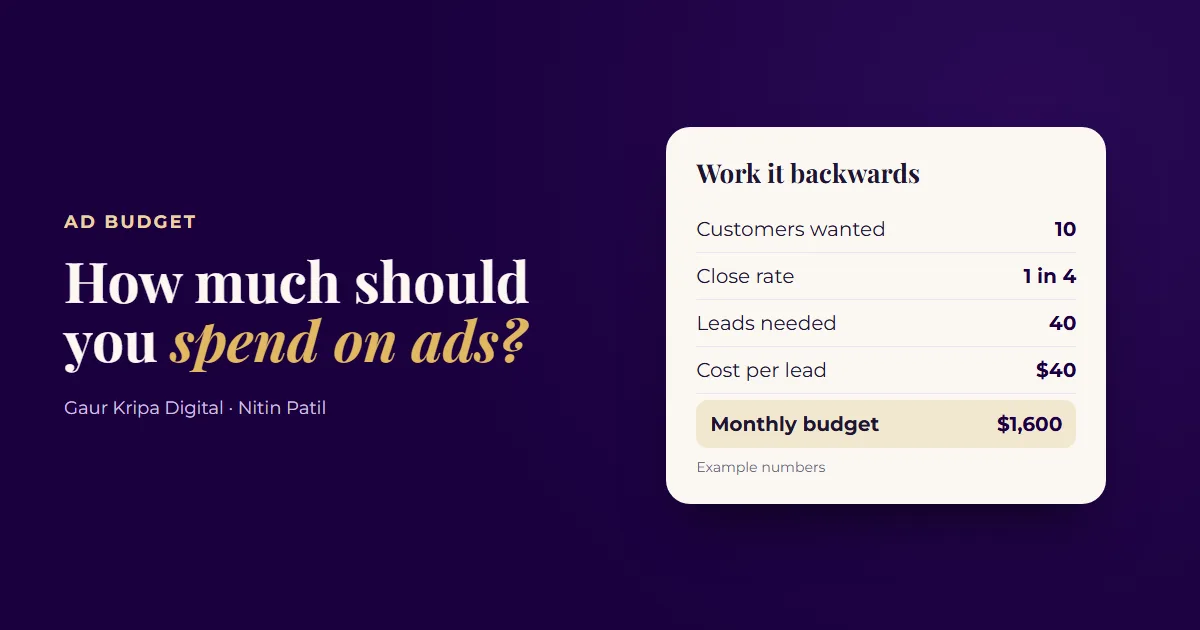
"How much should I spend on ads?" is the first question most owners ask me, and the usual answers don't help. "Spend 5 to 10% of revenue" tells you nothing about whether that money will bring in work. "Start with $10 a day and see" usually means the campaign never gets enough data to learn anything.
There is a better way. Start from the result you want and work backwards.
The short answer: monthly ad budget = customers you want ÷ your close rate × your cost per lead.
The four numbers you need
You only need four numbers, and you probably know three of them already.
- How many new customers you want each month. Be realistic about how many you can actually serve.
- Your close rate. Out of every 10 people who call or fill in a form, how many become paying customers? If you don't track this yet, look back at last month's enquiries and count.
- Your cost per lead. What one call or form fill costs from your ads. If you have never run ads, use a cautious guess for now and replace it with your real number after the first month.
- What a customer is worth to you. The profit from one job, or from one customer over a year if they come back.
Working it through
Here is an example with made-up but typical numbers for a local service business.
- You want 10 new customers a month.
- You close 1 in 4 enquiries, so you need 40 leads.
- Your leads cost $40 each.
- 40 leads × $40 = $1,600 a month in ad spend.
That's your starting budget. It's tied to a goal, so you can judge it honestly at the end of the month.
Here is the same math for three different goals, with the close rate and cost per lead kept the same:
| Customers wanted | Close rate | Leads needed | Cost per lead | Monthly ad budget |
|---|---|---|---|---|
| 5 | 1 in 4 | 20 | $40 | $800 |
| 10 | 1 in 4 | 40 | $40 | $1,600 |
| 20 | 1 in 4 | 80 | $40 | $3,200 |
Your close rate changes everything
The number most owners overlook is the close rate. Keep the goal at 10 customers and the cost per lead at $40, and only change how many enquiries you turn into customers:
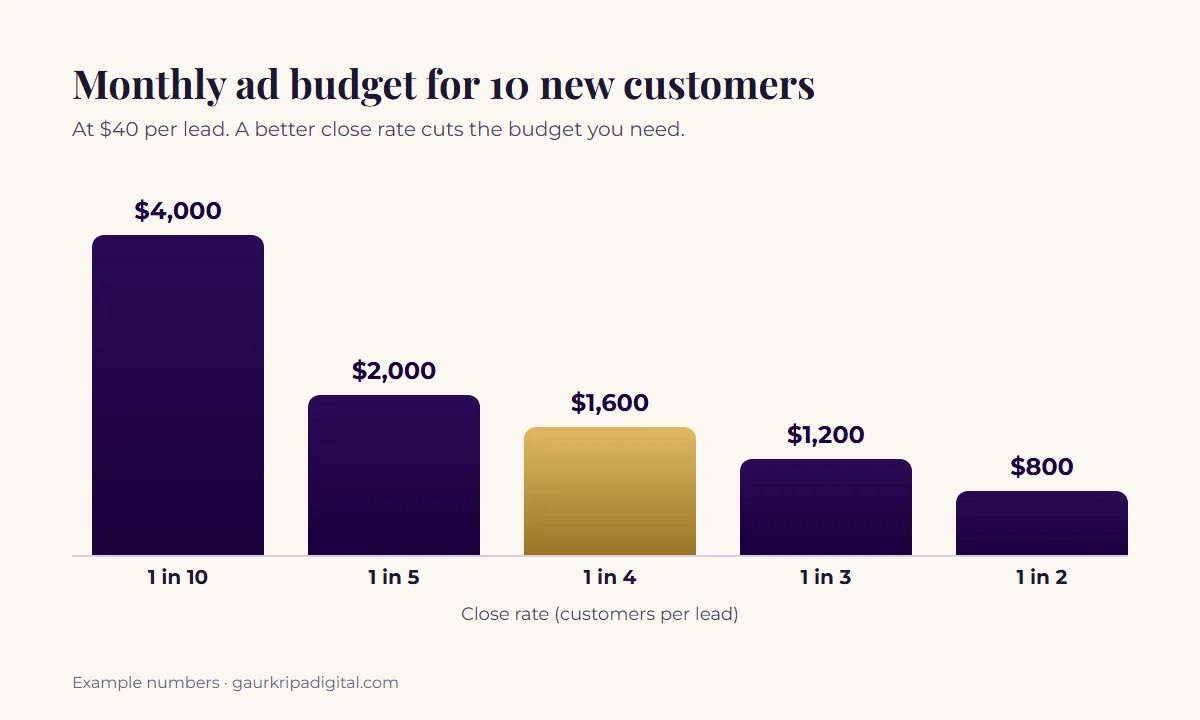
Example numbers. A better close rate cuts the budget you need for the same result.
Going from 1 in 5 to 1 in 3 cuts the budget from $2,000 to $1,200 for the same 10 customers. That's why replying fast and following up often saves more money than any ad tweak.
Now check it against what a customer is worth. If each new customer brings in $600 of profit, 10 customers are worth $6,000, and $1,600 of ad spend is a good deal. If each customer is worth $100, the same plan loses money, and no amount of ad tweaking fixes that. You would need a better offer, a higher price or a better close rate first.
When the math says "not yet"
Sometimes the honest answer is that ads won't pay right now. Common reasons:
- The close rate is low because leads wait hours for a reply, or nobody follows up after the first call. Fixing this is often cheaper than buying more leads. Lead follow-up automation is built for exactly this.
- The offer is weak. "Call us for a quote" competes with every other business. A clear offer, a guarantee or a fast booking slot gives people a reason to pick you.
- The budget is too small to learn. If your budget only buys a handful of leads a month, you can't tell a good ad from a lucky one. Fewer campaigns with more budget each beat many tiny ones.
Your first month is for learning
Your first month of cost per lead is a guess. Treat month one as a test:
- Track every lead and where it came from.
- Write down which leads turned into customers.
- At the end of the month, replace the guesses with your real cost per lead and real close rate, and run the math again.
By month two or three you will know what a customer actually costs you to win, which is the number that makes every later budget decision easy.
A quick worksheet
Copy this and fill in your own numbers:
- Customers wanted per month: ___
- Close rate (customers ÷ leads): ___
- Leads needed (customers ÷ close rate): ___
- Cost per lead: ___
- Monthly ad budget (leads × cost per lead): ___
- Profit per customer × customers wanted: ___ (should be well above the budget)
Once you know your budget, the next question is where to spend it. Facebook and Instagram ads suit offers people don't search for yet, and Google Ads catch people already searching for your service.
If you'd like a second pair of eyes on your ad account, the free ad account audit gives you the top 3 fixes in writing, done by me personally.
Frequently asked questions
How much should a small business spend on Facebook ads?
Work it out from your goal: customers you want ÷ close rate × cost per lead. For many local service businesses that lands between a few hundred and a few thousand dollars a month. Spending less than your cost per lead × 10 or so each month usually gives too little data to learn from.
Is 5 to 10% of revenue a good ad budget?
It can be a rough ceiling, but it ignores how much a customer is worth to you and how well you convert leads. Start from the customers you want and check the result against your profit per customer.
How long before I know if my ad budget is right?
Give it a full month. Then replace your guessed cost per lead and close rate with real numbers and redo the math.